Showing posts with label Writers Workshop. Show all posts

Tuesday, January 21, 2014

How to Do a Writing Workshop

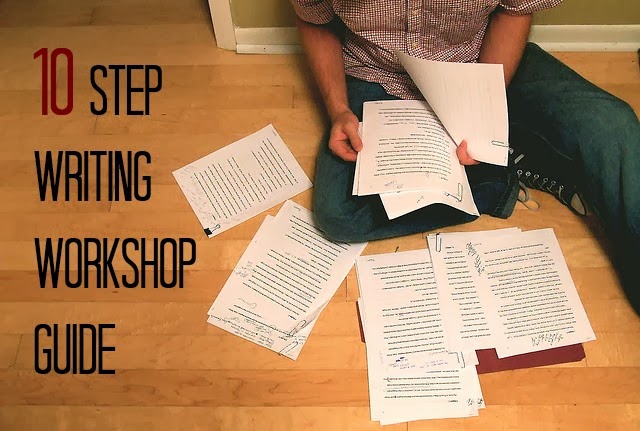
10 easy steps to a writers workshop
Photo Modified from Greg Turner, Flickr
A few months ago, my writing buddies and I started the Berea Writers Circle. At our most recent meeting, we studied "The Art of Critiquing," focusing on peer-critiques. Some people call these "critique groups," others call them "writing workshops," I consider those terms interchangeable.

Many chapters and articles are written on the subject of how to do a writing workshop. For our Writers Circle, my husband John and I made this 10-point guide based on material from Ursula K. Le Guin’s Steering the Craft and Susan Bell’s The Artful Edit (along with other articles and our own experience).

Before the Workshop

  1. Submit a short section of writing a few days before the meeting so that everyone has adequate time to consider and comment. 
  2. When critiquing another’s work, read straight through before marking corrections. You may want to note first impressions. 
  3. Go back through the text. 
    • Mark spelling and grammar. 
    • Point out what doesn’t work—confusing language, misunderstandings.
    • Write down questions you have.  
    • Include praise for the good parts—saying what works can sometimes be more helpful than saying what doesn’t work. 

    During the Workshop

    1. Meet with the group and take turns sharing your impressions. Be mindful of the amount of time you spend talking. 
    2. Listen quietly to others’ critiques. 
    3. Be honest and respectful. Treat other's work as you would like your own treated. 
    4. Avoid comments such as “I love it,” or “I don’t like this,” without explaining why. Include a suggestion with every criticism. 
    5. Focus on major issues. (The writer can read your minor comments later.) 
    6. Keep the comments about the work, not about the writer nor what you would have written. 
    7. After a piece has been workshopped, the writer may briefly respond. 
    Members of critique groups should commit to a regular meeting time (be it monthly, weekly, etc.), and communicate with each other regarding absences. You can send your section of writing via email a few days before. Some people mark the document using their word processor's comments and track changes functions and send it back via email. Others like to print it out and bring handwritten comments to the workshop. Do whatever feels comfortable. 

      Friday, March 29, 2013

      The importance of writers critique groups

      A writer is not an island unto herself. I do write for myself, and I think it is important to do so. But writing doesn't come alive until it is read. A writer needs an audience just as the reader needs the author.

      Still, I get nervous about the idea of some one else reading my work. It's scary. What if they judge me? I've learned to accept that we are all scared, and that most people are too worried about being judged by others to judge me to harshly.

      When I started writing, I did it for myself. (Because the story was inside me and it needed to get out.) But I wrote with the intention of it being read. Hopeful by some one outside my family. That where the critique group comes in. For me, this is a safe environment where I can share my work and get direct feed back.

      I am a member of two local writers groups.  For me, meeting in person is an important part of the process because it insights conversations that can lead to new inspiration and ideas. My reviewer can give feedback and I can ask questions about why she felt that way. However, there are also online critique groups that some writers find helpful.  That being said, be careful who you let read your work.  Show your work to other writers who you respect and trust.

      The two groups I'm part of utilize different methods.  One group meets weekly. We email our chapters or short stories before hand, read and comment on each others works, and then come together to talk about it.  We don't need to mention every typo circled because the author has a copy of each critique, but we discuss key points of improvement.  The other group meets twice a month and we bring sections to read aloud.  This gives the audience the chance to hear the flow and continuity of the piece and focus on what works for the over arching whole.  No one is going to catch your typos for your this way, but it is a chance to get feed back on how the story works over all.

      The purpose of a writers group is to help the individuals with their craft. Before reviewing each others works, we all agree that we are going to critique in a constructive way. We note specifically what works and what doesn't. The comments always refer to the writing not the writer. The author is, of course, takes what she can from the reviews, accepting or rejecting as she sees fit.

      Sunday, March 24, 2013

      In the beginning

      I'm going about this out of order.  At the writers workshop I attended a few weeks ago, the presenter, Silas House, started out by talking about beginnings.  If you read my previous post, you'll see I mused first on characterization.  And I am only now talking about beginnings.  It's my blog; I do what I want.  My thoughts aren't always well organized, okay?

      I attended the writers workshop in hopes I could improve my own writing, and I heard some really good tips that will help me on my quest to publish a novel. This post is going to be mostly ideas I stole straight from Silas's lecture on the topic of writing good beginnings. When writing a book, a great beginning needs three things: mystery, a love story and trouble. Stories all need to start out with a thesis or central question.  The story is answering that question. This sets up the tension that drives the story.

      They mystery is the element of suspense that drives the reader to read more.  Now, I don't mean the book has to start out "It was a dark and stormy night..." or be about solving a crime.  But it is crucial to start with some suspense, some unanswered question that needs resolving, otherwise the story isn't going to be very interesting.

      Good beginnings also need a love story. Now, this doesn't have to be a romance novel--a love story is really any emotional relationship between the characters.  There are so many different kinds of love and so many different kinds of relationships. It can be a story about friends, or even a hate story about enemies. In my current work in progress, the story starts out with a relationship between father and daughter as its love story.

      To write a good beginning, the characters need to start out in trouble, and the rest of the book can be about getting them out of trouble trouble.  No body wants to read about happy people; that's boring. Start the story with trouble when the characters are unhappy, and end the book as soon as they become happy.

      A few more keys to a good beginning: start out with either action or a strong voice, drop the reader in the middle of the action as near to the end as possible. It's important to have a balance of information and avoid an info dump.  Instead weave the back story throughout the work. The beginning of the work is like making a promise to the reader.  It sets the stage as to what to who work will be like.


      Saturday, March 2, 2013

      Characterization

      I went to a writers workshop given by author Silas House at Berea College the other night. I have to admit, I've yet to read his books, but several are going on my to-read list.  He shared a lot of good information, and I am still trying to digest it all. Writing my thoughts and feelings on his topics and how it applies to my own writing might help me.

      I've been thinking about characters. Something Silas emphasized during this workshop was creating a balance between physical attributes and personality.  It doesn't matter if the character has blue eyes and blond hair. The physical description needs to reveal the soul of the character. This is an area that needs improvement for me. My characterizations tend to focus on looks.  When I should be zooming in on one or two distinct details and letting the readers imagination fill in the rest. I know it's cliché to say eyes are the window to the soul, but I think eyes do reveal depth of the characters. I tend to gravitate towards eyes in my writing.

      During his talk, Silas gave an example from his own work. The guy was a "throw away" character operating the Farris wheel. When he gave the minute detail of a dirty sucker stick in his mouth, the character exploded into life in my head.  I've seen that guy. One tiny detail, and I know exactly what he looks like.

      Every character need a defining trait. Is she stingy, for example? Or selfless? Exploring the why of the defining trait helps develop the character.  Also, characters need "warts." Nobody's perfect. No human is without faults.  How do their faults and their traits interact to build an individual? As a writer, I think it is important for me to know theses things about my characters weather or not I directly reveal them to the audience.  Because the underlying structure subtlety supports the believability and helps readers relate.

      Characters need secrets, too.  People don't reveal all of themselves to everyone.  The secret helps drive tension in the story.  This is a gem of writing advice.  I worried that my characters don't have secrets, and I discussed it with John this morning over breakfast.  We came to the conclusion that my protagonist does have a secret which she only shares with those closet to her, but keeps from the world at large. I need to take time to think about each of my characters and figure out what their secrets are.